In 1925, the Deutsche Reichsbahn initially bought a few experimental small locomotives. These locomotives had internal combustion engines, which were later to replace steam traction. After the tests had been positive, the Reichsbahn classified further procurement into two performance groups starting in 1931:
– Power group I: Locomotives up to 39 hp and max. 30 km/h speed. They were intended for switching operations in small stations under simple conditions
– Power group II: Locomotives from 40 – 150 hp. They were intended to enable trained personnel to carry out shunting tasks in one-man operation
The letter K was introduced to identify the locomotives, followed by an index for the type of engine used: b (benzene) for gasoline engines and ö (oil) for diesel engines. For locomotives with a liquid gearbox, the letter “f” was added.
On the German Federal Railways they were known as class 311 or 321-324 from 1968 and on the German Reichsbahn as class 100 in 1970.
This locomotive is an example of the so-called standard small locomotives of the Deutsche Reichsbahn. After the testing of a fluid gearbox instead of the original gearbox at the end of 1937, more locomotives were ordered with this gearbox. After the end of the Second World War, only a fraction of the once existing small locomotives were operational. Since the demand for switcher locomotives was high after the war, further examples were procured or replicated.
Our locomotive was delivered to the Deutsche Reichsbahn in 1934 as Kö 4290. In 1943, the locomotive was converted to liquid gas operation and renumbered Kb 4290. After the war, the locomotive was converted to diesel operation again and was renumbered Kö 4290. In 1955, the existing gearbox was replaced by a liquid gearbox (Köf 4290). In 1968, the locomotive was given the designation 321 023-4 and was rebuilt again in the same year (322 143-9). After it was taken out of servicein Koblenz in 1975, it was sold to the company J. B. Weinand, Bad Kreuznach (“Lok 1”). In 1991, the locomotive came to our museum and received its designation Köf 4290 again.
MANUFACTURER
YEAR OF CONSTRUCTION
WITHDRAWAL FROM SERVICE
MAX. SPEED
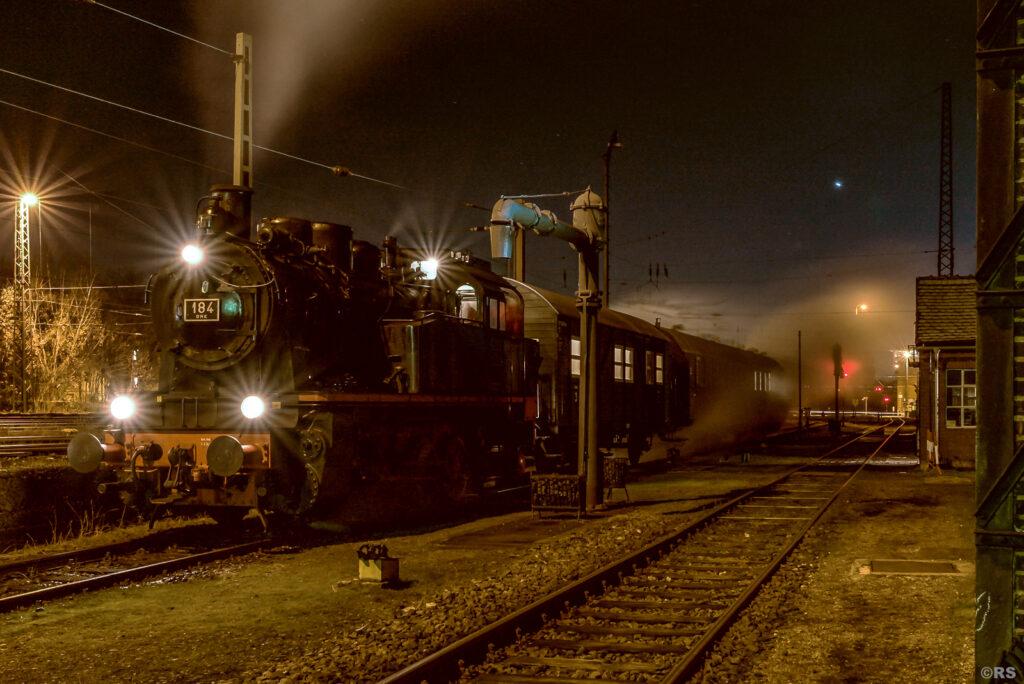
Hop on the steam train, hauled by 23 042, at Darmstadt or Bensheim, and experience the German Grape Harvest Festival with Palatinate wine, local specialities and live music. Alternatively, railway enthusiasts can take the iconic ‘Kuckucksbähnel’ and the ‘Sissi’ steam locomotive through the idyllic Elmstein Valley – a special outing for connoisseurs and lovers of railway nostalgia!
On 7 and 8 November 2026, take a historic steam train from Darmstadt Central Station to the Dieburg St Martin’s Market!
The St Martin’s Market awaits you with the season’s first mulled wine and a wide range of other culinary and craft delights. The special train runs three times a day, there and back.
On the 3rd Sunday of Advent, 13 December 2026: Special steam train journey to the Heidelberg Christmas markets!
From Darmstadt or Bensheim, we’ll take you to the enchanting Christmas markets in the various squares along the Hauptstraße, with views of the illuminated Heidelberg Castle.
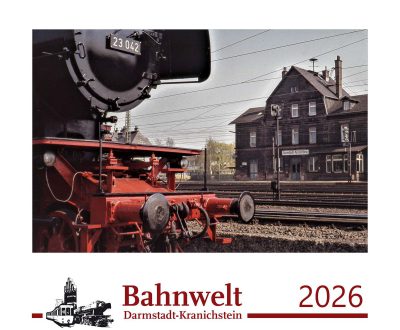
Mit unserem Jubiläumskalender feiern wir 50 Jahre Eisenbahnmuseum Darmstadt-Kranichstein – eines der bedeutendsten Eisenbahnmuseen Deutschlands. Die zwölf eindrucksvollen Motive zeigen dabei verschiedene Exponate im Kontext unvergesslicher historischer Meilensteine aus fünf Jahrzehnten gelebter Eisenbahnkultur.
For better reading, the masculine form is used for personal names and personal nouns on this website. Corresponding terms apply in principle to all genders for the purpose of equal treatment. The abbreviated form of language is for editorial reasons only and does not imply any valuation.
Sie erhalten in Kürze eine E-Mail an die von Ihnen angegebene E-Mail-Adresse. Bitte bestätigen Sie Ihre Newsletteranmeldung über den darin enthaltenen Link.